

Legal Policy Concerning the Criminal Act of Defamation on Social Media Based on a Criminal Law Perspective
Arranged By : Lintang Revorieza, S.H
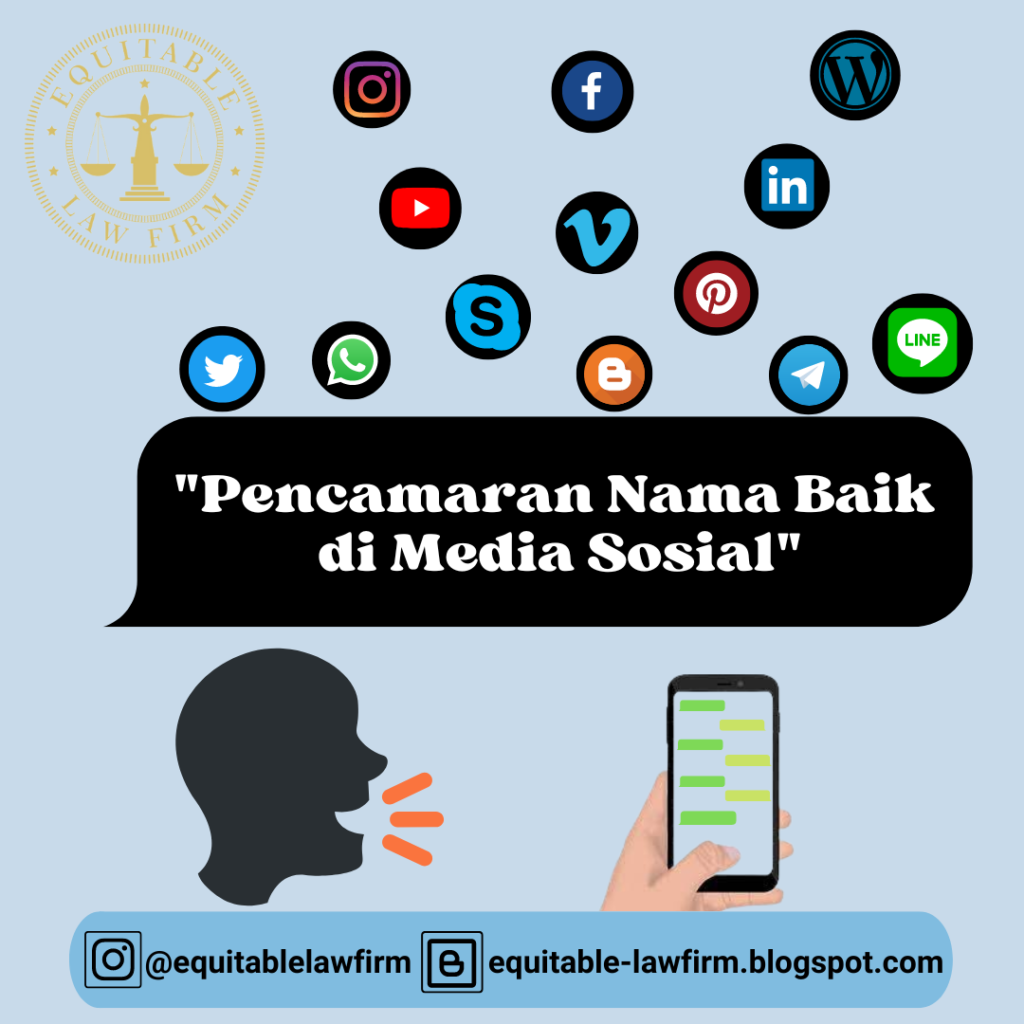
Lately, the issue of defamation has been widely debated among the public. Several celebrities have also experienced defamation issues on social media, so this case has become a highlight among the public. The case that was highlighted by the mass media, causing discussion among the public, is the case of Jerinx SID who became a suspect in the case of alleged defamation of the Indonesian Doctors Association (IDI) Bali. Jerinx was charged with Article 29 in conjunction with Article 45 B of Law Number 19 of 2016 concerning Amendments to Law Number 11 of 2008 concerning Information and Electronic Transactions (hereinafter referred to as the ITE Law) and Article 27 paragraph (4) in conjunction with Article 45 paragraph (4) ) UU ITE.[1]
Apart from Jerinx, there are many other cases related to defamation on social (cyber) media, for example the case that was experienced by Ningsih in Gorontalo for writing statuses and comments on her Facebook account which were considered defamation, then a similar case was also experienced by artist Medina. Zein who was policed for defaming a celebrity named Marissya Icha on his Instagram account.[2]
Defamation is the act of someone who deliberately tarnishes the good name or reputation of another person, causing a bad opinion of that person. Based on the Criminal Code, defamation can be done orally or in writing (print). In the Criminal Code it can be said defamation if it fulfills two elements, namely there is an element of accusation and the accusation is explained as public consumption. Defamation is included in the complaint offense case. The Criminal Code explains that acts of defamation are regulated in Articles 310 to 321.[3]
It can be explained briefly that what is meant by defamation is attacking someone’s honor or good name. This is a general understanding of the offense of defamation. It also explains the special nature of defamation or also called species delict, namely; defamation or defamation regulated in Article 310 paragraph 1, written defamation or defamation regulated in Article 310 paragraph 2, slander regulated in Article 311, minor insult regulated in Article 315, complaints of slander regulated in Article 317, false prejudice regulated in Article 318, and defamation of a person who has died is regulated in Article 320.
Criminal acts of defamation and criminal acts of insult are regulated in the Criminal Code in Chapter XVI concerning insults. Defamation and insult look similar at first glance. Both are subjective and public crimes, meaning that there is an act of offending and offending a person’s dignity. In the criminal act of defamation in the Criminal Code there are special insults and general insults. Specific insults are outside the Criminal Code, there are 19 forms of criminal acts regulated in the ITE Law no. 11 of 2008 from Article 27 to Article 37. The crime of special insults is one of the 19 forms of criminal acts. The criminal offense of insult is specifically regulated in Article 27 paragraph 3. If seen in detail, there are the following elements; Objective elements: (1) Actions in distributing, transmitting and facilitating access, (2) Against the law without rights, and (3) The object is in electronic information, which has issues related to insult and/or defamation.[4] ]
Article 310 of the Criminal Code explains the rules for defamation, which are divided into 3 paragraphs. In paragraph 1; Anyone who commits an attack on a person’s honor or reputation by accusing something that is obvious with the aim that the public knows a lot, is threatened with defamation, by imprisonment for a maximum of 9 months or a fine of up to three hundred rupiahs. Furthermore, in paragraph 2; it is explained that the said act was committed in writing or with an image that was distributed in public, then those who have disseminated it are declared guilty of defamation and are subject to imprisonment for a maximum of 1 year and 4 months or a maximum fine of three hundred rupiahs. Then, in verse 3; if the act is clearly carried out in the public interest or in the interest of self-defense, it is emphasized that the said act is not included in the form of defamation or written defamation.[5]
BIBLIOGRAPHY
YUD, 2020, “Case of Defamation, Jerinx SID Becomes a Suspect”, News One, https://www.
Noviandi, Ferry 2021, “Medina Zein Is Again Politicized by Marissya Icha, Turns Out This Is the Case”, Suara Com, https://www. -icha-it turns out-this-is-the-case
Moeljatno, 2008, Pi Law Book
[1] https://www.beritasatu.com/nasional/664715/kasus-pencemaran-nama-baik-jerinx-sid-jadi-tersangka
[2] https://www.suara.com/entertainment/2021/10/29/145540/medina-zein-kembali-dipolisikan-marissya-icha-ternyata-ini-kasusnya
[3] Moeljatno, 2008, Kitab Undang-Undang Hukum Pidana, PT Bumi Aksara, Jakarta.
[4] UU No. 19 Tahun 2016 tentang Perubahan Atas Undang-Undang Nomor 11 Tahun 2008 Tentang Informasi Dan Transaksi Elektronik
[5] Kitab Undang-Undang Hukum Pidana